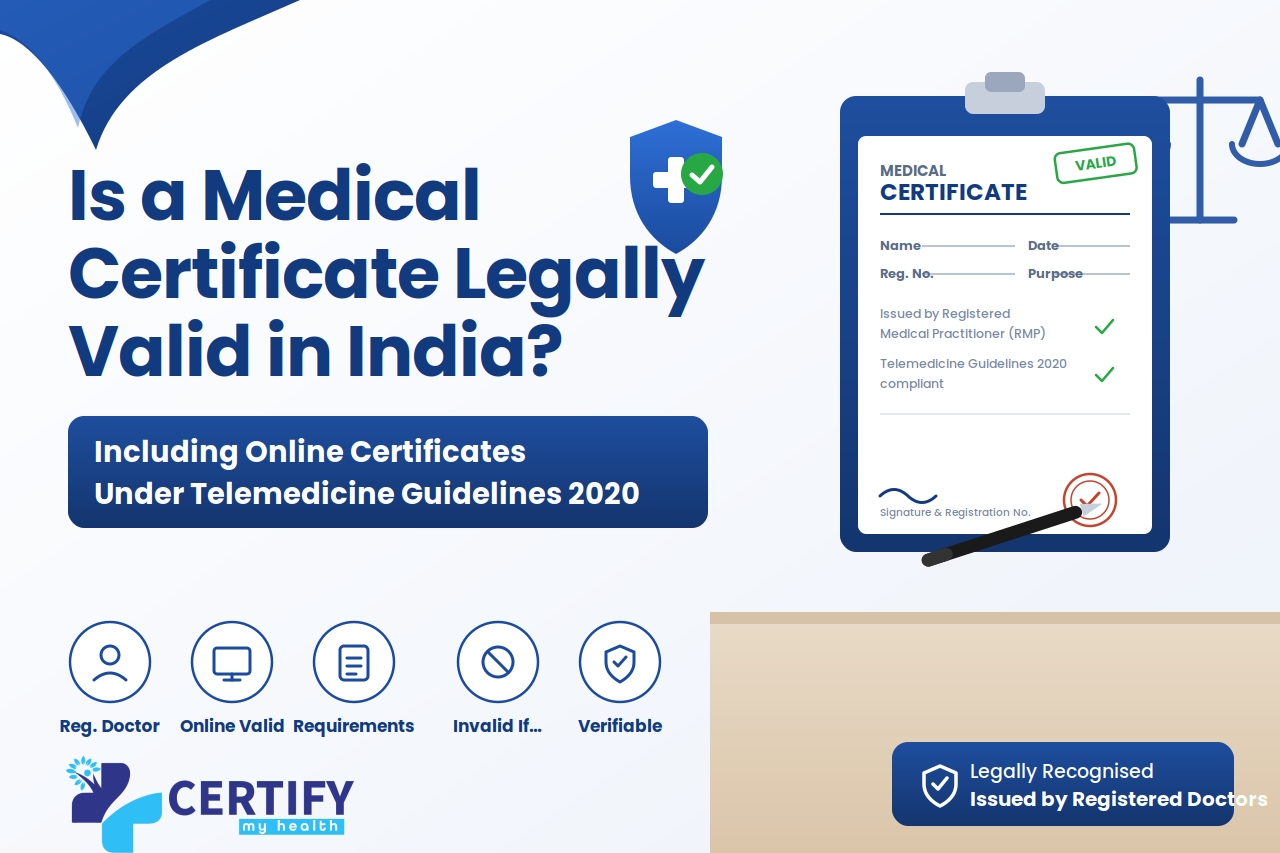
From sanctioning leave at work to confirming an illness for a college, supporting an insurance claim, or backing a legal submission, a medical certificate is one of the most commonly requested documents in India. And as more of these services move online, one question keeps coming up: is a medical certificate—especially one issued online—actually legally valid in India?
The short answer is yes, provided it meets certain conditions. This guide explains what gives a medical certificate legal standing in India, the central role of a registered doctor, what a valid certificate must contain, when a certificate can be treated as invalid, and how online certificates fit within the law.
At a Glance
- Are they valid? Yes—medical certificates issued by a Registered Medical Practitioner (RMP) are recognised in India for workplace, academic, insurance, and many other purposes.
- Who can issue one: A doctor registered with the relevant State Medical Council or the national register, with a valid registration number.
- Are online ones valid? Yes, when issued after a proper consultation under India's Telemedicine Practice Guidelines, 2020.
- What makes it valid: The doctor's name and registration number, consultation and issue dates, the condition or purpose, any rest advised, and the doctor's signature or digital authentication.
- What makes it invalid: No genuine consultation, an unregistered issuer, missing registration details, or a reused or altered document.
- How acceptance works: Whether a specific certificate is accepted still rests with the employer, institution, or authority receiving it.
What Is a Medical Certificate?
A medical certificate is a formal document issued by a registered doctor that records a person's health status for a stated purpose. People use them to apply for sick leave at work or school, to obtain a fitness clearance, to support a work-from-home request, to back an insurance claim, or to provide documentation for legal and administrative processes.
Its function is straightforward: to verify and document a health status, condition, or fitness in a form that employers, educational boards, insurers, or authorities can rely on. That reliance, though, depends on the certificate meeting the professional and legal requirements described below.
Are Medical Certificates Legally Valid in India?
Yes. A medical certificate carries legal standing in India when it is issued by a Registered Medical Practitioner (RMP)—a doctor whose name appears on the register maintained by the relevant State Medical Council or the national medical register, in line with the framework established under the Indian Medical Council Act, 1956 (and now administered under the National Medical Commission Act, 2019).
For the certificate to be relied upon, it should clearly include:
- The full name and registration number of the issuing doctor
- The date of consultation and the date of issue
- The relevant illness, medical condition, or purpose, as appropriate
- The period of rest or leave advised, where applicable
- The signature and official stamp of the doctor, or a valid digital authentication
A certificate missing these elements may be questioned, rejected, or—if it misrepresents facts—treated as fraudulent. Misuse can carry disciplinary and, in some cases, legal consequences for the person submitting it. You can see how these details appear on a properly issued document among our sample certificates.
It's worth being clear on one point: legal validity means the certificate is a legitimate medical document. Whether a particular workplace or institution accepts it for a given purpose is a separate matter, decided by that organisation's own policies.
Are Online Medical Certificates Valid in India?
This is the question most people ask today, and the answer is yes—online medical certificates are legally recognised in India, as long as they are issued through proper medical practice.
The Telemedicine Practice Guidelines, 2020 formally enabled registered doctors to consult patients remotely and to issue prescriptions and documentation digitally. In other words, a consultation conducted online, and a certificate issued from it, are recognised under Indian law when done correctly.
An online certificate stands on the same footing as an in-person one when:
- The consulting doctor is a registered medical practitioner
- The consultation involves genuine questioning and assessment appropriate to the situation
- The certificate carries the doctor's registration number, authentication or digital signature, and contact details
- The document is stored securely, with a means of verifying its authenticity
The key point is that the certificate must result from a real consultation. An online certificate is valid because a doctor assessed the patient remotely—not because it was issued without any assessment at all.
Why Legal Validity Matters
A medical certificate is often submitted as evidence—for a leave application, a rescheduled exam or trip, an exemption, or a legal matter—and its legitimacy can later be checked. If the document lacks the required details or wasn't issued by a qualified, registered doctor, it can:
- Be rejected by an employer or institution
- Lead to penalties or disciplinary action at work
- Create complications in a legal or administrative process
- Undermine the credibility of the person who submitted it
Legal validity, then, isn't a mere formality. It's what allows employers, institutions, and authorities to trust the document—and it protects the person relying on it.
What Makes a Medical Certificate Invalid?
Because certificates are sometimes misused, not every document presented as one holds up. A certificate may be treated as invalid when it is:
- Issued by an unregistered practitioner or an unverifiable source
- Missing the doctor's registration number or official authentication
- Based on no genuine consultation or assessment
- A duplicate, reused, or altered document
- Downloaded as a template from the internet with no medical backing
If an organisation identifies a certificate as false, the consequences can be serious—ranging from rejection of the document to disciplinary action at work or an academic penalty. This is precisely why obtaining certificates only through registered doctors matters.
How CertifyMyHealth Supports Legal Validity
CertifyMyHealth is built to provide quick, secure, and legitimate access to medical documentation. Here's how the service is structured to keep certificates genuine and reliable:
Registered doctors only. Every consultation is conducted by a Registered Medical Practitioner with a valid medical registration.
Telemedicine-compliant process. Consultations follow India's Telemedicine Practice Guidelines, and documents are handled digitally and securely.
Fast turnaround. Where a certificate is issued, it is typically delivered within about 90 minutes during business hours—without cutting corners on the assessment.
Simple, remote process. Submit your request, consult a registered doctor online, and receive your document from home.
Secure handling. Personal and health information is handled confidentially, in line with the Privacy Policy.
Built for verification. Certificates carry the doctor's credentials and, where applicable, a verification facility so the receiving organisation can confirm authenticity.
A certificate is issued only when the consulting doctor considers it clinically appropriate—the assessment always comes first.
A Note on Acceptance
Most Indian employers, schools, and universities accept a valid online medical certificate, particularly when it clearly shows the doctor's credentials and registration, states the relevant condition or purpose, and matches the dates and duration involved. This applies across common certificate types—whether it's a medical certificate for sick leave, a medical fitness certificate, or a work from home medical certificate. That said, acceptance policies vary between organisations. If your workplace or institution has a specific format or submission rule, check it, so your certificate meets their requirement the first time.
Frequently Asked Questions
Are medical certificates legally valid in India?
Yes. A medical certificate is legally valid in India when issued by a Registered Medical Practitioner whose registration details appear on the certificate, along with the relevant dates and the condition or purpose.
Are online medical certificates valid in India?
Yes. Online medical certificates are recognised under India's Telemedicine Practice Guidelines, 2020, provided they follow from a genuine consultation with a registered doctor and carry the required authentication.
Who can issue a valid medical certificate?
Only a Registered Medical Practitioner—a doctor registered with the relevant State Medical Council or the national register, with a valid registration number.
What must a valid medical certificate contain?
The doctor's name and registration number, the consultation and issue dates, the relevant condition or purpose, any rest or leave advised, and the doctor's signature or digital authentication.
What can make a medical certificate invalid?
Issuance by an unregistered person, a missing registration number or authentication, no genuine consultation, or a duplicate, reused, or altered document.
Does a valid certificate mean my employer must accept it?
No. Legal validity means the certificate is a legitimate medical document. Whether it is accepted for a specific purpose depends on the policies of the employer, institution, or authority receiving it.
Is an online certificate as valid as an in-person one?
Yes, when it results from a proper online consultation with a registered doctor and carries the required registration and authentication details.
How quickly can I get a certificate from CertifyMyHealth?
Where a certificate is issued, it is typically delivered within about 90 minutes during business hours, via WhatsApp or email.
Can a doctor decline to issue a certificate?
Yes. A certificate is issued only when the consulting doctor considers it clinically appropriate after assessing the person.
Is my information kept confidential?
Yes. Personal and health information is handled securely and confidentially, in line with the Privacy Policy.
Final Thoughts
Medical certificates are legally valid in India—in both physical and digital form—when they come from a Registered Medical Practitioner and include the required details. Online certificates are also recognised under the Telemedicine Practice Guidelines, 2020, as long as they follow a genuine consultation. The essentials to remember: a registered doctor, a real assessment, and complete registration and authentication details on the document.
If you need a certificate for medical leave, fitness, insurance, or administrative purposes, CertifyMyHealth connects you with registered doctors for a secure online consultation, with documentation issued only when the doctor considers it clinically appropriate.
Need a genuine, valid medical certificate? Consult a registered doctor online through CertifyMyHealth.